Blue Whale
Part of Hall of Ocean Life.
 Alvaro Keding/© AMNH
In fact, the blue whale is the biggest animal ever known to have existed. It's even bigger than the enormous dinosaurs that lived over 65 million years ago.
This colossal species uses plates of baleen in its mouth to filter huge numbers of tiny prey, including small crustaceans called krill. Blue whales migrate long distances, traveling alone or in small groups called pods. They breed in warm southern waters during the winter and feed in polar seas during the spring and summer.
The Annotated Blue Whale Model
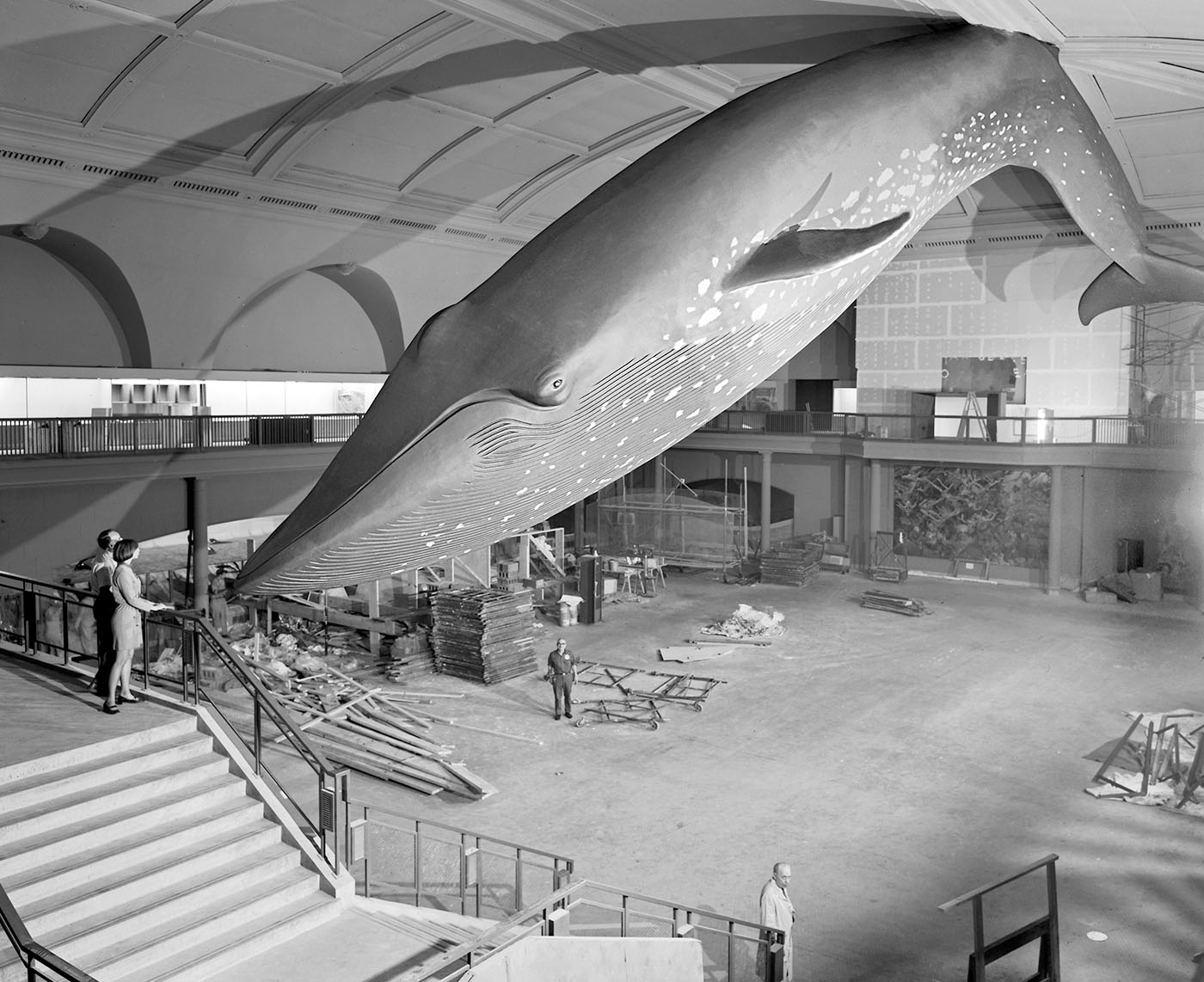
The Museum's iconic blue whale model, first constructed in the mid-1960s, was based on photographs of a female blue whale found dead in 1925 off the southern tip of South America. At the time, little was known about blue whales in their natural habitats.
Click on the + signs below to find out more about the Museum's blue whale model.
Gone to Pieces
This model replaced a 76-foot-long plaster model of a blue whale created in 1907 for what was then the Hall of the Biology of Mammals on the fourth floor. Some of the old model’s pieces were sold as memorabilia at auction in 1974. A woman who bid $530 for a glass eye said, “Once you look in the eye of a whale, you never forget it.”
Record Setter
On November 1968, the whale’s body was lifted up to the ceiling as two halves: the 66-foot-long front section and the 28-foot-long tail. The Hall of Ocean Life and Biology of Fishes opened on Wednesday, February 26, 1969, and the next Sunday, more than 35,000 people came to see the whale—setting a new attendance record for the Museum.
Source Material
When the Museum redesigned the Hall of Ocean Life in anticipation of its 100th anniversary in 1969, artist Richard Ellis received one of the biggest assignments: designing the new life-sized blue whale model. But the first photographs of living whales underwater weren’t taken until the mid-1970s. So Ellis had to rely on eyewitness descriptions— and extrapolate from photos or casts of whale corpses.
True to Life
The very last detail added to the model were 28 tiny hairs on the whale’s chin. To determine their placement, the preparators consulted the Discovery Reports, dispatches by a British Museum expedition on whaling in the Antarctic. But they forgot about the belly button. That wasn’t added until the hall was renovated in 2003 and became the Milstein Hall of Ocean Life.
Whoosh!
During the planning phase, Richard van Gelder, then chair of the Mammalogy Department, refused suggestions to depict the blue whale with its mouth open. He argued it would be scientifically inaccurate for a whale that was poised to dive— and also too tempting as a target for “potential basketball stars.”
Cutting Room Floor
Other scrapped plans? Depicting a beached whale, accompanied by a soundscape of scavenging birds and faux phosphorescent bacteria. Propping it atop a 3-foot-diameter pedestal on its belly. Surrounding it with artificial water and three killer whales in a walk-in habitat group. Floating a rubber model filled with helium (van Gelder thought it “too much like the Macy’s Thanksgiving parade.” )
By 2001, Museum artists working on the renovation of the 94-foot-long model had many more images and live footage of blue whales. They flattened the model's once overly-bulging eyes, corrected the blowholes, and tapered the tail. They also added a belly button–which visitors can find about four-fifths of the way down the model's body, a reminder of just one of the traits humans share with this majestic mammal.
At 21,000 pounds of foam and fiberglass, how does the model stay up? It's suspended by a single steel pipe, connected to structures hidden in both the model and the ceiling.
#WhaleWash
Each year, the blue whale model receives a thorough scrub. What does it take to clean this massive exhibit? Three days, an electric lift, an industrial vacuum cleaner, and strong arms! See for yourself in the video below.
